


1921“Had He Lived”: Jesse Gander of Brook Street, Cuckfield
On 13 January 1921, an official letter was issued from the Army’s Record Office at Dover. Addressed to Mr A. Gander at Jasemine Cottage, Brook Street, Cuckfield, it accompanied a British War Medal awarded to a soldier who would never wear it.
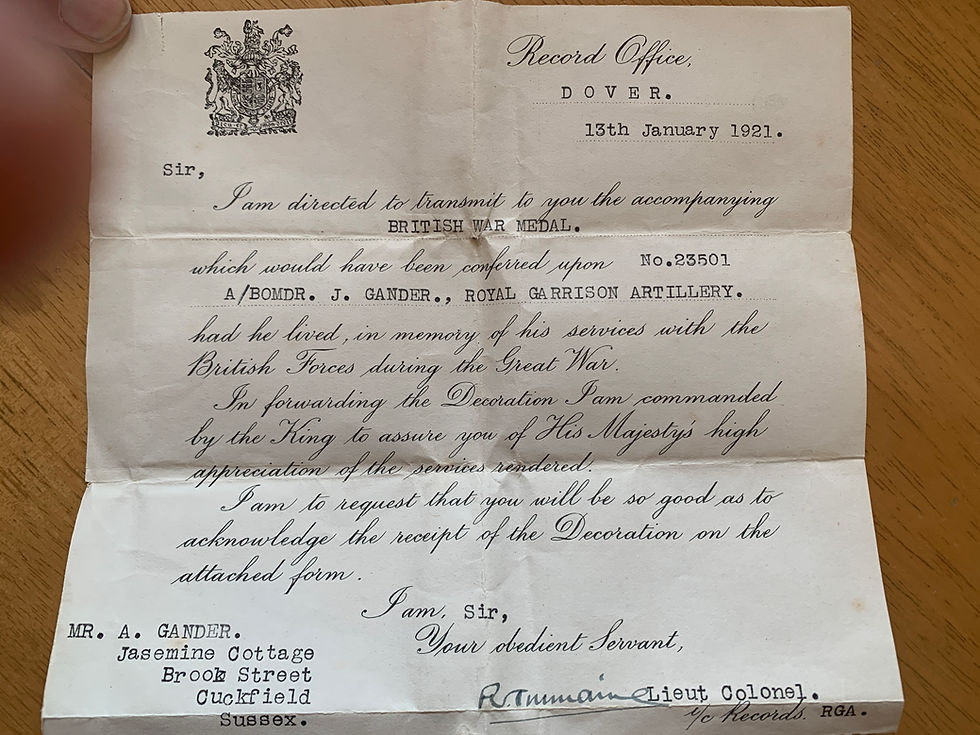
The soldier was Jesse Gander. More than five years earlier, on 28 December 1915, he had died in India, aged twenty-eight. The letter’s carefully printed words explained that the medal “would have been conferred upon” him “had he lived”.

Today, the surviving letter, medal and labelled cardboard box bring one of the names on Cuckfield’s war memorial into sharper focus. They connect a Sussex cottage with a soldier’s grave thousands of miles away.
A Cuckfield family
Jesse was the son of Albert and Annie Gander, whose address in the published casualty records is Jesamine Cottage (accurate spelling Jasmine Cottage), Brook Street. The variations in the spelling of the cottage’s name are small; the correspondence and records plainly refer to the same family. The letter’s recipient, “Mr A. Gander”, was almost certainly Jesse’s father, Albert.
An online Gander family genealogy places Jesse’s birth in 1887 and identifies his mother as Ann Godsmark. It describes him as one of eleven children, with six brothers and four sisters. These family-tree details still require confirmation against original records, but they suggest a substantial family rooted in the district.
There are supporting traces in the published transcription of Cuckfield’s baptism registers. Henry, son of Albert and Ann Gander, was baptised on 2 May 1880; Alice, daughter of Albert and Annie Gander, on 7 May 1882. Both names appear among Jesse’s siblings in the family genealogy. These entries offer glimpses of the family before the war, when its history was being recorded through births and baptisms rather than casualty lists.
From Sussex to India
The Cuckfield Roll of Honour records that Jesse was born in Cuckfield and enlisted at Haywards Heath. He served as number 23501 with the 60th Heavy Battery, Royal Garrison Artillery. The medal letter describes him as an Acting Bombardier.
The surviving objects preserve slightly different descriptions of his rank. On the box he is “Gnr. J. Gander, R.A.”—Gunner J. Gander, Royal Artillery. In the letter he is “A/BOMDR. J. GANDER, ROYAL GARRISON ARTILLERY”. The service number is identical on both, providing the firm link between them. The precise reason for the difference in rank would need his military records to resolve.
Jesse’s story takes us beyond the familiar landscape of trenches in France and Belgium. His wartime service brought him to India, where he died shortly after Christmas 1915. The local Roll of Honour records his death as being from disease. The particular illness has not yet been established, and neither has the date on which he joined the Army.
He was buried in Roorkee Cemetery. The published transcription of his Commonwealth War Graves Commission entry also records his commemoration on Face 5 of the Madras 1914–1918 War Memorial, in what is now Chennai.
That distant memorial has a particular purpose. It commemorates men buried in cemeteries across India where the permanent maintenance of their graves could not be assured. Roorkee is among the cemeteries listed in its historical account. Jesse’s association with Madras therefore does not mean that he died there or was buried there.

The medal that came home
The British War Medal was instituted in July 1919 to recognise qualifying wartime service abroad. Its introduction after the fighting had ended helps explain why Jesse’s family received this correspondence in 1921, years after his death. Service in India could qualify for the award.
The medal survives with its distinctive ribbon: an orange centre bordered by white, black and royal blue. The photographed reverse shows St George on horseback, with a fallen eagle shield and the emblems of death beneath the horse. Above is the rising sun of victory. The other face bears the portrait of George V.
Its imagery proclaims victory. The accompanying letter speaks of absence.
It tells the recipient that the medal is sent in memory of Jesse’s service during the Great War, conveys the King’s appreciation, and requests acknowledgement on an attached form. The language is formal and restrained. Yet the words “had he lived” make the purpose of the package painfully clear.
We cannot know how Albert and Annie responded when the medal reached Brook Street. No account of that moment has been found. What survives is the object itself, its box and the letter: official recognition of a young man’s service, sent to the home to which he had not returned.
A name remembered
Jesse Gander is listed among Cuckfield’s First World War dead. His name belongs to the village’s public remembrance, alongside those of other local men whose lives were lost during the conflict.
The medal and letter preserve something more personal. They give us a service number, a family address and a father’s name. They connect Brook Street with Roorkee and show how the consequences of a distant war reached into an ordinary Cuckfield household.
Jesse died at twenty-eight. Had he survived until the letter was written, he would have been about thirty-three. Instead, the medal came home in his place.
More than a century later, these modest surviving objects allow us to remember the man behind the inscription: Jesse Gander of Cuckfield, son of Albert and Annie, who died far from home.
Many many thanks to Cuckfield lover Fred Wheatland for sharing the information and showing this medal and accompanying poignant letter.
Visit Cuckfield Museum! https://cuckfieldmuseum.org/


Comments