


2000: A Review of the construction of Balcombe Tunnel
Through the Clay and the Controversy: Inside the Making of the Balcombe Tunnel
A summary of THE BUILDING OF THE BALCOMBE TUNNEL, 1838-1841 by Pat Millward
in SUSSEX INDUSTRIAL HISTORY (Journal of the Sussex Industrial Archaeology Society volume 30)
For today’s rail passengers, the Balcombe Tunnel is just a momentary plunge into darkness on the busy London–Brighton line. In the late 1830s, however, it represented one of the most contentious and socially disruptive engineering projects of the railway age. Built between 1838 and 1841, the tunnel was not only a technical challenge but a focal point for fears about safety, labour, cost and control. It exposed the uneasy relationship between Victorian faith in progress and the realities of landscape, geology and human effort.
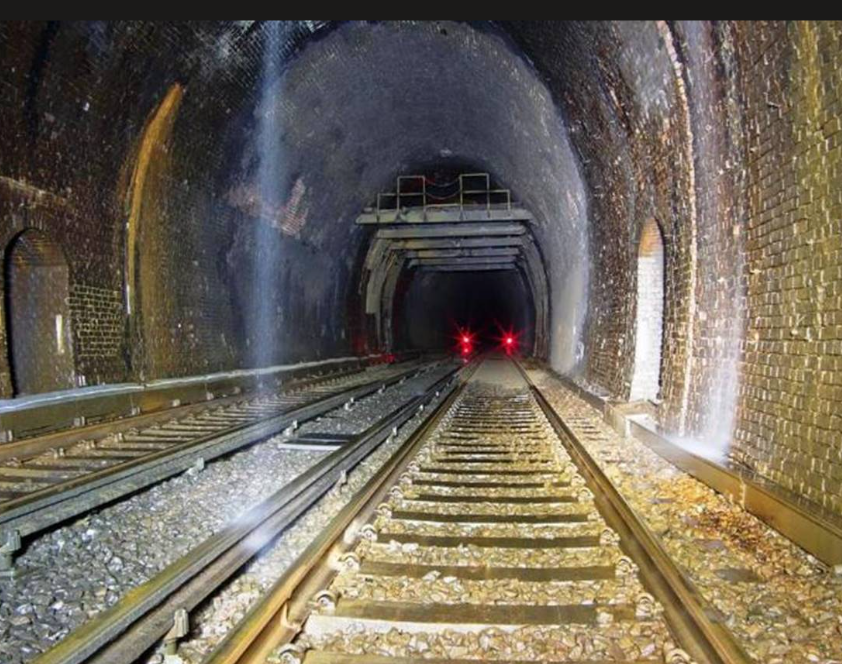
The ambition to link London directly with Brighton had been circulating for decades. William James, an energetic early promoter, proposed railway routes as early as 1823¹, long before public opinion or capital markets were ready. His ideas laid the groundwork for later schemes, most notably those developed by Sir John Rennie². Rennie’s surveys offered two starkly different choices: a longer, gentler route skirting the Weald, or a shorter “Direct Line” cutting straight through its ridges. The latter promised speed and commercial advantage, but required major tunnelling at both Balcombe and Cuckfield, making these two villages central, if reluctant, players in the scheme.

Cuckfield’s relevance was crucial. Situated on high ground south of Balcombe, it lay at the heart of the Wealden ridge and forced engineers to confront the problem of elevation. Rennie’s early proposals included a substantial tunnel near Cuckfield to maintain acceptable gradients for locomotives of the period. Critics such as Robert Stephenson argued that the combined difficulty of the Cuckfield and Balcombe tunnels made the entire Direct Line impractical⁴. Even when later revisions reduced or removed the Cuckfield tunnel, the gradients in the area remained a point of contention, reinforcing the argument that the High Weald was fundamentally hostile to railway construction.
These disputes played out dramatically in the Parliamentary enquiries of 1836 and 1837. Rennie faced sustained criticism from Stephenson, John Parker Bidder and others, who questioned his geological assumptions, costings and construction timelines⁴⁻⁹. Tunnels themselves were controversial structures, widely associated with danger. Medical experts warned of smoke, stale air and physical shock, and there were even claims that long tunnels posed risks to pregnant women or those of “delicate constitution”¹⁰. Under intense cross-examination, Rennie faltered, conceding errors and appearing less assured than his rivals². Yet despite this, the Direct Line survived, aided by revised plans developed with John Urpeth Rastrick and Joseph Locke³⁻⁶, and by Brighton’s determination to secure the fastest possible connection to London.
Once Parliamentary approval was secured, the focus shifted from theory to labour. The construction of the Balcombe Tunnel brought hundreds of navvies—itinerant manual workers—into a quiet rural area unaccustomed to such an influx. Navvies were widely perceived by local communities as disruptive and dangerous: hard-drinking, rough-mannered and prone to violence. Newspapers and parish records frequently associated them with crime, disorder and moral decline. As a result, their presence prompted anxiety among landowners and villagers alike, leading to increased policing and close supervision.
In reality, navvies were essential, highly skilled workers whose strength and experience made large-scale railway construction possible. At Balcombe, they worked in exhausting and hazardous conditions, sinking shafts, hauling spoil, laying brickwork and constantly battling water ingress. Temporary huts, beerhouses, workshops and even a dedicated police post appeared in the woods, creating a transient industrial settlement in the heart of the Weald. Discipline was enforced strictly by contractors, and wages were docked for drunkenness or absence, reflecting the contradictory Victorian attitude toward navvies: both feared as unruly and exploited as indispensable.

Geology proved as troublesome as critics had predicted. The Wealden clay swelled when exposed to air, collapsed without warning and channelled water into the works. Flooding was persistent, delays mounted and costs rose to roughly three times the original estimates. By the time the tunnel was completed in 1841, it was already known to leak—an issue that has never entirely disappeared. Nonetheless, inspectors passed it as fit for traffic, and trains soon began running through it as part of the newly opened line to Haywards Heath.
In the decades that followed, repeated repairs, drainage works and relining confirmed that Balcombe was not a tunnel that could simply be finished and forgotten. Yet its success cemented the viability of the Direct Line and diminished the significance of Cuckfield as a railway centre, leaving the village bypassed by the main line it had once threatened to obstruct. Together, Balcombe and Cuckfield illustrate the balance of power in railway development: engineering judgement, parliamentary approval and economic logic ultimately outweighed local disruption and human cost.
The Balcombe Tunnel endures as a monument to Victorian ambition, labour and compromise. Every train that passes through its damp brickwork carries echoes of the navvies who dug it, the engineers who argued over it, and the communities reshaped by it, reminding us that progress was never smooth, and never solely technical.
Footnotes: Key Figures
William James (1771–1837) – Early railway promoter and surveyor whose ambitious proposals helped inspire later schemes.
Sir John Rennie (1794–1874) – Civil engineer and chief advocate of the Direct Line to Brighton; central figure in the parliamentary controversies.
John Urpeth Rastrick (1780–1856) – Engineer and locomotive designer who revised Rennie’s plans and oversaw construction.
Robert Stephenson (1803–1859) – Britain’s leading railway engineer; principal critic of the Balcombe and Cuckfield works.
George Stephenson (1781–1848) – Pioneer railway engineer who supported objections to the Direct Line.
Joseph Locke (1805–1860) – Engineer who supported the Direct Line and advised on tunnelling methods.
Francis Giles (1787–1847) – Civil engineer involved in re-surveying alternative routes.
Arthur Rennie Briggs – Solicitor and parliamentary agent representing Rennie.
John Parker Bidder (1805–1878) – Engineer known for his calculating abilities; supported Stephenson’s criticisms.
Dionysius Lardner (1793–1859) – Scientist and writer who gave evidence on tunnel ventilation and health.
David Mocatta (1806–1882) – Architect to the London and Brighton Railway Company.
Sir Timothy Shelley (1753–1844) – Landowner at Balcombe who negotiated compensation for land taken for the tunnel.


Comments